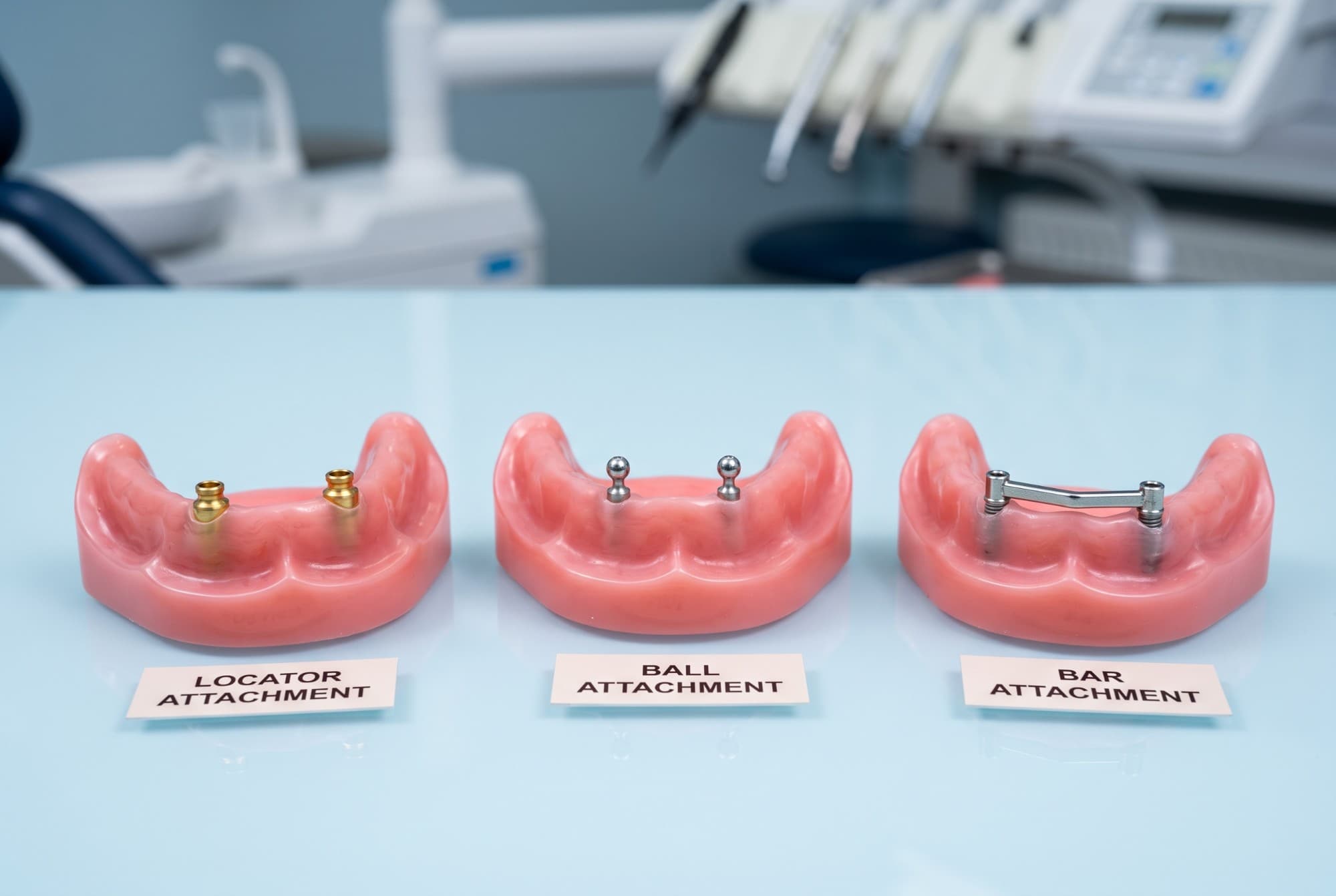

Every patient asks some version of the same question before treatment: "What is it actually going to feel like?" Fair question — and one that deserves a more honest answer than the stock photos of laughing seniors biting into apples. The truth is that the first month with an implant-retained overdenture has a real learning curve. It's short, it's manageable, and it ends in the same place for almost everyone — but you should know what's coming. Here's what genuinely happens, week by week, based on what our patients tell us at their follow-ups.
Day 1: The snap
The fitting appointment has a moment we never get tired of: the first time the denture clicks onto the implants and the patient bites down. After years of a lower denture that floated and shifted, the sensation of teeth that do not move is startling — several patients have described it as "solid ground." You'll practice snapping it in and out a few times before you leave (there's a small knack to it — press with thumbs, don't bite it into place), and we fine-tune the snap tension so removal is deliberate but not a wrestling match.
Also true of day one: your mouth knows something is different. The overdenture's shape isn't identical to your old denture — it's usually slimmer, and on an upper the palate may now be open. Different is the point, but your tongue will spend the first days investigating.
Week 1: New muscle memory
The clip-in fit itself feels solid from day one — that part isn't gradual. What takes adjusting is everything around it:
- Tender spots. Some patients notice mild tenderness where the attachments engage, or pressure points as gums adapt to a new load pattern. Normal, and exactly what the first follow-up adjustment is for.
- Speech. A few sounds — usually "s" and "th" — can feel slightly off for the first days while your tongue relearns its landmarks. Reading aloud for ten minutes a day speeds this up remarkably. Most people report speech feels normal within a week.
- Salivation. Your mouth may briefly produce more saliva; it's treating the new shape as novel. It settles within days.
- The removal routine. Snapping it out the first few nights feels awkward; by night five, it's automatic.
Eat on the softer side this week — not because the denture can't handle more, but because your gums and muscles are recalibrating. Think pasta, fish, eggs, soft breads.
Weeks 2–3: Eating comes back
This is usually the turning point, and it's the part patients light up about at follow-ups. Foods that quietly disappeared from your life years ago start coming back — an apple you bite instead of slice, a proper steak, corn on the cob, crusty bread that would have unseated your old lower by the second bite.
The reason it feels fundamentally different: with a traditional denture, bite force pinches your gums between denture and bone, and your gums cry uncle at around 20–30% of natural chewing force. With an overdenture, force transfers through the implants into your jawbone — the way teeth are supposed to work — so you can chew with intent instead of caution.
Two honest notes for this stage: go gradually with the hardest foods (very sticky or hard items deserve respect a while longer), and chew on both sides — balanced chewing seats the denture evenly and speeds the adaptation. By the end of week three, most patients are eating close to normally and have stopped pre-planning their menu around their teeth.
Day 30: The "I forget I'm wearing it" moment
By the one-month mark, the thing almost every patient tells us is the same, in nearly the same words: they stop thinking about their denture entirely. No more checking it's seated before you laugh. No more hand hovering near your mouth in conversation. No more scanning restaurant menus for what's "safe." It clips in each morning, it stays put all day, and your brain quietly deletes the background process that monitored your denture for years — which is really the whole point of the treatment.
The daily rhythm by now is simple: snap in after breakfast cleanup, forget about it, snap out at night, brush the denture and the attachment points, brush around the implants in your mouth, done. Two minutes, morning and night.
Is it like this for everyone?
Direction, yes; speed, no. Some patients feel fully settled by week two; others take closer to six weeks, particularly with an upper arch, where the palate change adds one more thing for the tongue to relearn. Patients coming from decades with a traditional denture sometimes take longer simply because their muscles have years of compensating habits to unlearn. What doesn't vary much is the trajectory: it gets better every week, not worse.
One thing to take seriously: if something feels consistently wrong past the first couple of weeks — a sore spot that isn't fading, a snap that feels loose, a bite that meets unevenly — don't tough it out. That's precisely what follow-up visits are for, and small adjustments make a disproportionate difference. Toughing it out just delays the good part.
Thinking about making the switch?
If you're currently fighting a loose lower denture, the honest starting points are these: our candidacy guide (most people qualify, even with bone loss), and what implant dentures actually cost — flat $5,250 per arch for the overdenture, surgery quoted separately. The first 30 days ask a little patience of you. Every month after that pays it back.
Thinking about your options? Book a free, no-pressure consultation with Damien John Hiorth DD at Dentures Direct in North York. Honest assessment, clear pricing, and we'll tell you if you're not a candidate too.
Frequently asked questions
How long does it take to get used to snap-on dentures?
Most patients feel largely adjusted within 2–3 weeks and report forgetting the denture entirely by about day 30. Speech typically normalizes within the first week; eating confidence builds through weeks two and three. Upper arches can take slightly longer than lowers.
Do snap-on dentures hurt at first?
Mild tenderness and pressure points in the first week are common as your gums adapt to a new load pattern — but real pain is not normal. Persistent sore spots are fixed with small adjustments at your follow-up visit, so never simply tough them out.
Will snap-on dentures affect my speech?
Some sounds — usually "s" and "th" — may feel slightly off for the first few days while your tongue adjusts. Reading aloud for ten minutes a day speeds adaptation, and most patients report normal speech within a week.
When can I eat normally with implant dentures?
Eat softer foods the first week, then reintroduce firmer foods through weeks two and three. By the end of the first month, most patients are eating steak, apples, and corn on the cob — foods they had given up with a traditional denture. Give very hard or sticky foods a bit longer.
Is it hard to snap the denture in and out?
There is a small knack — press it in with your thumbs rather than biting it into place — and it becomes automatic within a few days. We also tune the attachment tension at fitting so removal is deliberate but never a struggle.

Damien John Hiorth DD
Founder & Lead Denturist · 25 years · Dentures Direct, North York Toronto