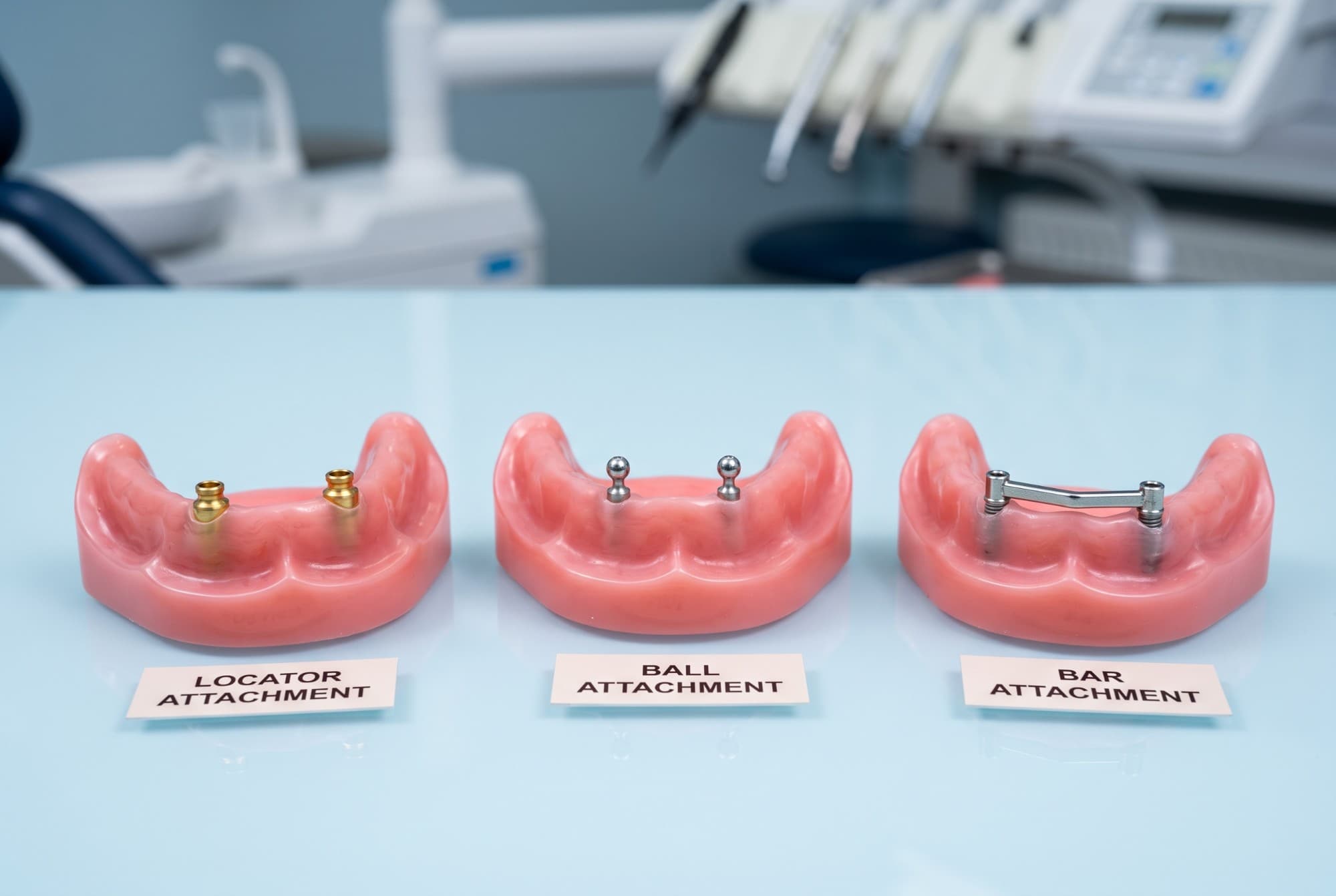

Before "does it hurt" and before "what does it cost," this is usually the very first question I get about snap-on dentures: how many implants am I actually looking at?
It's a fair thing to want pinned down early, because that number drives almost everything else — the surgery, the healing, and a real chunk of the price. Here's the honest answer, including the part where the number isn't quite the same for everyone.
The standard answer: 3 on the lower, 4 on the upper
For most patients, a snap-on overdenture uses 3 implants in the lower jaw and 4 implants in the upper jaw. That difference isn't arbitrary.
The lower jaw generally has denser bone, so fewer implants placed toward the front — where that bone is strongest — can support a stable overdenture. It's also the arch that causes almost all the grief in a conventional denture, since a lower plate has no suction to hold it, so it's usually the one patients are most motivated to fix.
The upper jaw is the opposite case: the bone is naturally softer, and many upper overdentures are designed horseshoe-shaped with an open palate so patients get their sense of taste back. Leaving that palate open means the denture has less surface area gripping the tissue, so the fourth implant makes up the difference in support.
Why your number might not match your neighbour's
3 and 4 are the standard starting point, not a rule stamped on every patient. A few things genuinely move that number:
- Bone quality at the specific sites. A CBCT (3D) scan shows exactly how much bone you have and where. If a planned site is thinner than ideal, your surgeon may shift a position, add a graft, or occasionally add an implant to spread the load differently.
- The shape and span of your arch. A wider or unusually shaped ridge sometimes needs the implants spaced differently to support the denture evenly end to end.
- Implants you already have. If you had implants placed years ago — even by a different clinic — and they're healthy and reasonably positioned, we design your new overdenture around whatever is already there. Sometimes that's the standard count, sometimes it's more or fewer than we'd have planned from scratch.
- How much of a safety margin you want. Some patients elect for one extra implant purely for redundancy. It isn't usually necessary with a well-planned standard count, but it's a legitimate personal choice to discuss at your consult.
The number itself is decided by your oral surgeon, based on the CBCT scan — not by me guessing from a chart. My part is designing and milling the overdenture to snap securely onto however many implants you end up with.
What each implant adds to the cost
This is where the number really matters to your wallet, so let's do the math honestly rather than wave at a range.
The overdenture itself is a flat fee: $5,250 per arch, or $10,000 flat if you're doing both arches. That part doesn't change no matter how many implants support it.
The implant surgery is billed separately by the oral surgeon, and it's priced per implant — typically $1,500 to $3,000 each, depending on your bone and whether any grafting is needed. Across our referred patients last year, the average actually paid worked out to about $2,273 per implant.
Run that through the standard counts and you get a realistic ballpark:
- Lower arch, 3 implants: roughly $6,819 in surgery (3 × $2,273) plus the $5,250 overdenture — about $12,000 all-in.
- Upper arch, 4 implants: roughly $9,092 in surgery (4 × $2,273) plus the $5,250 overdenture — about $14,300 all-in.
- Both arches, 7 implants total: roughly $15,911 in surgery (7 × $2,273) plus the $10,000 flat overdenture fee — about $25,900 all-in.
Those are averages, not quotes — your own number depends on your bone and your surgeon's fee. The full breakdown, with more example math, lives on our implant denture cost page.
Already have implants from years ago?
This comes up more than you'd think, and it's good news when it does. If your existing implants are healthy and reasonably positioned, your surgery is already behind you — your only remaining cost is the overdenture itself, and we can often have it ready in 2 to 4 weeks.
The honest bottom line
3 lower, 4 upper is where almost every plan starts. Whether yours ends up exactly there comes down to your bone, your arch, and what (if anything) is already in your mouth — and the only way to know for certain is a CBCT scan, not a guess from a general number like this one. Come in, and we'll map out your actual number, your actual surgeon's estimate, and an honest total before you commit to anything.
Thinking about your options? Book a free, no-pressure consultation with Damien John Hiorth DD at Dentures Direct in North York. Honest assessment, clear pricing, and we'll tell you if you're not a candidate too.
Frequently asked questions
How many implants do I need for a lower snap-on denture?
Typically 3 implants for a lower overdenture. The lower jaw generally has denser bone, and implants placed toward the front of the ridge — where bone is strongest — are usually enough to support a stable snap-on denture.
Why does the upper jaw need more implants than the lower?
Usually 4 implants versus 3, mainly because upper jawbone is naturally softer. Many upper overdentures are also designed with an open palate for taste and comfort, which means less denture surface gripping the tissue, so the extra implant helps make up the support.
Can I get a snap-on denture with fewer implants than the standard count?
The final number is set by your oral surgeon based on a CBCT (3D) scan of your bone, not a fixed rule. It can occasionally be adjusted for bone quality or arch shape, but it is a clinical decision made from real measurements, not a preference to shop around for.
Do more implants mean a better result?
Not automatically. A well-planned standard count (3 lower, 4 upper) gives most patients a stable, secure overdenture. Extra implants add redundancy some patients want for peace of mind, but they are not usually necessary for stability on their own.
What does each additional implant add to the cost?
The overdenture fee itself is flat — $5,250 per arch or $10,000 for both — and does not change with implant count. The implant surgery is billed separately by the oral surgeon, typically $1,500 to $3,000 per implant, so each additional implant adds roughly that amount to your total.

Damien John Hiorth DD
Founder & Lead Denturist · 25 years · Dentures Direct, North York Toronto